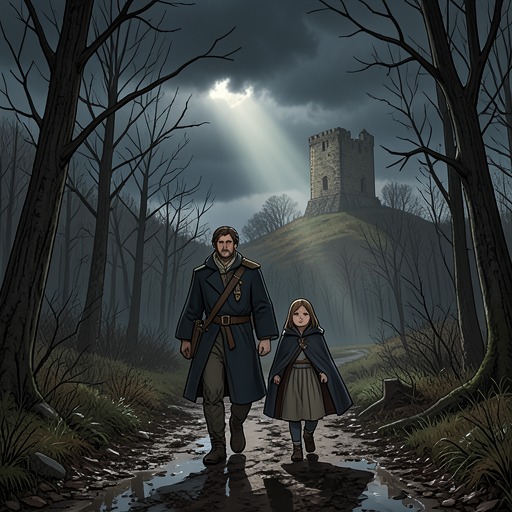
Morgan
Interview with the VampireMorgan is an English painter encountered by Louis and Claudia during their search for the vampires of Eastern Europe. He arrives in a remote village on honeymoon with his wife Emily, hoping to paint picturesque landscapes and visit a nearby ruined monastery, but becomes the witness to a graveyard exhumation, the victim of a vampire attack, and finally a newly made vampire whose helpless recognition of Louis exposes the emotional cost of the encounter. His story turns an abstract quest for origins into a confrontation with mindless undeath, provincial violence, and the limits of what the living can understand.
Identity and Arrival
Morgan introduces himself as an Englishman who has never previously left England. He tells Louis that he had been painting during a honeymoon journey with Emily, traveling through Germany and onward wherever the regular coaches would take them. His interest in scenery leads the couple into danger: they come to the isolated region because a ruined monastery nearby is reputed to be unusually well preserved, but the regular coaches do not reach the village, forcing Morgan to pay a farmer to carry them by cart.
His curiosity is both an artistic temperament and a fatal habit. When the farmer sees a commotion in the cemetery and refuses to investigate, Morgan finds the spectacle fascinating and eagerly goes forward alone, leaving Emily seated on their luggage. He treats the strange gathering as a picturesque local scene before recognizing that the villagers are not celebrating a procession but witnessing the violent destruction of a suspected vampire. His willingness to observe what he does not understand places him close to the grave, while his separation from Emily leaves her exposed in the village.
The Graveyard Testimony
Morgan recounts that the cemetery contains fresh graves, some marked by new wooden crosses and others still carrying newly placed flowers. The peasants stand motionless, watching two men hold a white Horse by the bridle. The animal paws, stamps, and shies away from the place, a physical sign of the terror that Morgan himself initially mistakes for spectacle. In an opened grave lies a woman buried for six months, her body still pink and apparently alive, her hands resting on her breast as though she were asleep.
The men test the corpse’s body, lifting one hand and examining it as if its joints were still living. They then drive a wooden stake through her breast and sever her head with a shovel. Morgan’s account is marked by disbelief and revulsion: he insists that an event of this kind cannot be understood until it has been seen. The villagers explain the violence as protection against a plague of vampires, claiming that the woman had been rising nightly to feed on the living. The scene supplies Louis and Claudia with the folk practices recorded in their books: staking, decapitation, and the burning of the vampire’s remains.
Morgan’s horror is intensified by the knowledge that Emily may suffer the same fate. He returns to her and tries to leave the village, offering money for a carriage, but no driver will take them away. Emily, who did not witness the exhumation, finds the events fascinating rather than terrifying, while Morgan understands that the danger has not ended. His attempt to protect her is shaped by a sharp division between himself and the villagers; he calls them barbarians and savages and appeals to Louis as a fellow civilized European. That appeal reveals both his desperation and the colonial assumptions through which he interprets the rural community.
Encounter with Louis and Claudia
Louis finds Morgan after the vampire attack in an inn where the dead woman’s body has been brought. Morgan is crying, clutching a leatherbound flask, and struggling to remain sane beside the corpse. He offers Louis liquor, presses his hand, and says that he needs him desperately. In response, Louis gives Morgan his own name, which he confides to almost no one. The exchange creates a temporary bond between two strangers: Morgan seeks human assistance, while Louis recognizes an opportunity to learn what has happened.
Morgan says that he brought Emily to the village but did not cause her death. His memories arrive unevenly through shock and alcohol; he speaks of the paintings, the book, the journey, and the picturesque landscape before returning to Emily and the corpse. Louis notices the preciousness of Morgan’s attachment when Morgan softly names the dead woman, but the recognition does not save him. The wounds on her throat reveal to Louis what Morgan cannot yet fully articulate: a vampire has attacked her.
Louis’s sympathy is complicated by predatory knowledge. He wants to learn from Morgan, yet he is also moved by the Englishman’s grief and confusion. Claudia watches Morgan closely, and when Louis later sees the marks on his throat, he understands that Morgan has been bitten and is already dying. The encounter therefore places Louis between compassion and the vampire imperative: Morgan is a distressed human being, but also a source of information and, potentially, blood.
Transformation and Death
After Louis and Claudia confront the creature in the ruined tower, they discover that Morgan has survived the vampire’s attack. The European vampire is a mindless, animated corpse, and Louis and Claudia destroy it with stones after a brutal struggle. Morgan lies separately across the floor, apparently motionless, while dawn approaches. Louis initially forgets him amid the exhaustion, earth, blood, and stench of the corpse, but Claudia notices that he is moving.
Morgan’s face appears in the moonlight with the vampire’s marks on his throat. When Louis approaches, Morgan recognizes him and repeatedly whispers his name. His eyes widen, his lips form a smile, and he reaches toward Louis with a bloody hand. The gesture is not the triumphant awakening of a conscious immortal; it is the confused, desperate recognition of a dying man who has been altered beyond recovery. Morgan seems blind to the ruined tower and the night around him, fixed only on the familiar face before him.
Claudia kills him before dawn. She pushes him against the stones, and when he reaches toward her and strokes her yellow curls, she drinks from him. Louis flees rather than participate. Claudia follows and orders him to return for Morgan, warning that Morgan is dying and that there is no time. Louis nevertheless carries Claudia away, refusing to answer her insistence that the sky is changing and that they must act. He takes the crucifix, drives the carriage back toward the village, and announces that the vampire has been destroyed while leaving Morgan’s remains behind.
Morgan’s fate becomes the immediate proof that the Eastern European vampires are not the conscious beings Louis and Claudia resemble. In later reflection, Louis remembers only a handful of such creatures: rotted, ragged bodies with empty eyes and bovine, wagging heads. One woman flees through a forest in a blood-stained burial gown, but offers no secret or truth, only despair. Morgan’s brief transformation thus ends not in knowledge but in the confirmation that the Old World vampire is usually a mindless corpse.
Narrative Significance
Morgan functions as a human witness, a failed convert, and a threshold figure between European folklore and Louis’s lived vampire identity. His testimony gives concrete form to the books Claudia has treated as a guide: the staking of the heart, the severing of the head, and the burning of the remains are not merely travelers’ tales. Yet the vampire discovered through Morgan is radically unlike Louis and Claudia, and the discovery destroys the hope that Eastern Europe will explain their origins.
His presence also exposes the instability of cultural interpretation. Morgan begins by aestheticizing the village, seeing its procession and rural setting through the eyes of a painter. When the spectacle becomes violence, he divides the world into civilized English and French men on one side and savage peasants on the other. The villagers, meanwhile, possess the practical knowledge that Morgan lacks: they recognize the threat as a vampire plague and know how to stop it. His language of civilization cannot protect Emily, restore his own body, or make the supernatural intelligible.
For Louis, Morgan’s final appearance intensifies the conflict between feeling and detachment. Louis can see the humanity in the grieving Englishman, yet he cannot prevent Claudia from killing him, and he cannot remain with him without confronting the necessity of the vampire’s appetite. The result is a reversal of the quest’s promise. Instead of finding teachers who can explain what they are, Louis and Claudia find bodies emptied of consciousness, a human companion reduced to the same condition, and a renewed fear that they may have destroyed the only other vampire capable of thought. Morgan’s tragedy is therefore not incidental: it is the scene through which their search for answers becomes a journey into despair.